Publications
2026
-
 Yingjian Song*, Jiayu Chen*, Zixuan Zeng, Yida Zhang, Zaid Pitafi, Deepak Kumar Das, Bradley G Phillips, Younghoon Kwon, William J Healy, Xiang Zhang, and othersProceedings of the ACM on Interactive, Mobile, Wearable and Ubiquitous Technologies, 2026
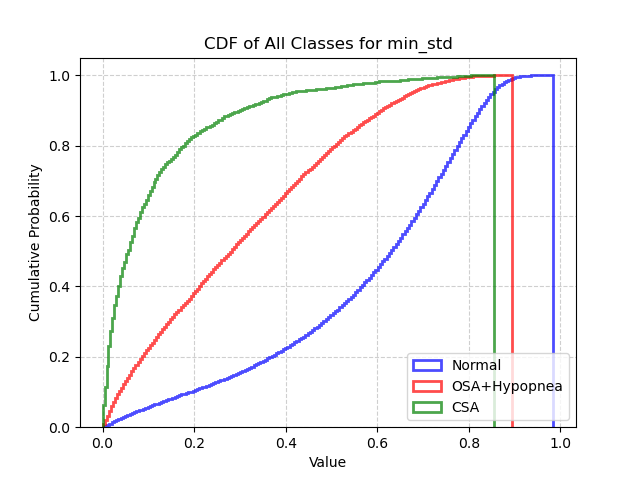
Sleep apnea is a prevalent yet underdiagnosed sleep disorder. Existing monitoring approaches largely rely on wearable devices or smartphone-based systems, which can be uncomfortable, require active user engagement, or be sensitive to environmental conditions. In this paper, we present a feasibility study of a contactless, engagement-free sleep-apnea screening approach using an under-bed horizontal (head-to-foot) seismic sensor that captures micro vibrations from respiration, heartbeat, and movement. We show that the horizontal axis provides a clearer respiratory signature than the vertical axis, enabling respiration-focused signal analysis. From the seismic signal, we extract 15 features across three families—respiratory heartbeat, and movement—and formulate a minute-level three-class classification task: Normal, OSA+hypopnea, and CSA. Using a strict patient-independent 5-fold cross-validation protocol on 116 subjects, we achieve 85.5% balanced accuracy and 80.6% macro F1 with a random forest classifier; class-wise balanced accuracies are 96.3% (Normal), 75.0% (OSA+hypopnea), and 85.2% (CSA). Overall, this work demonstrates the feasibility of under-bed seismic sensing for window-level apnea-related state classification.
@article{song2026contactless, title = {Contactless Sleep Apnea Detection with Bodyseismography}, author = {Song, Yingjian and Chen, Jiayu and Zeng, Zixuan and Zhang, Yida and Pitafi, Zaid and Das, Deepak Kumar and Phillips, Bradley G and Kwon, Younghoon and Healy, William J and Zhang, Xiang and others}, journal = {Proceedings of the ACM on Interactive, Mobile, Wearable and Ubiquitous Technologies}, volume = {10}, number = {2}, pages = {1--31}, year = {2026}, url = {https://dl.acm.org/doi/abs/10.1145/3810211}, doi = {10.1145/3810211} } -
 Yingjian Song*, Jiayu Chen*, Zixuan Zeng, Yida Zhang, Zaid Farooq Pitafi, Bradley G. Phillips, Xiang Zhang, Fei Dou, and WenZhan SongIEEE International Conference on Pervasive Computing and Communications, 2026
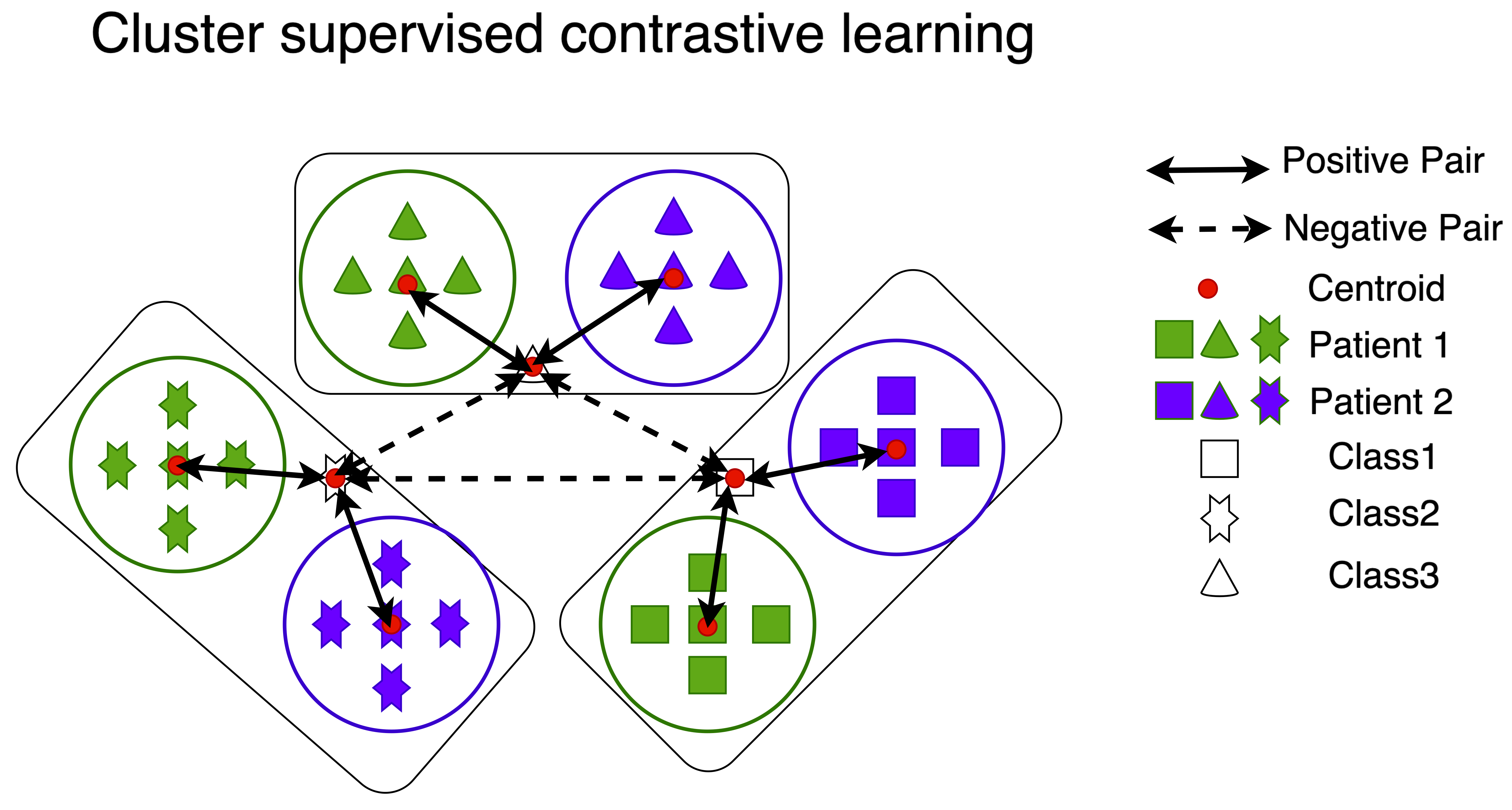
Snoring and breath-stopping are key symptoms of sleep apnea. Most existing studies primarily focus on wearable devices or smartphone-based systems. Wearable devices can be uncomfortable, while smartphone-based systems often require specific angles, distances, or positions, making them sensitive to environmental changes. This paper proposes a contactless and engagement-free system for snoring and breath-stopping detection using a seismic sensor. Distinguishing between snoring, breath-stopping, and normal breathing from raw data alone is challenging. Snoring features typically reside in a higher frequency range than breath-stopping and normal breathing, with breath-stopping features appearing in a lower frequency range. Calculating the differential and integral of raw data can enhance features in low and high frequencies, respectively. We introduce AFFCL, an attention feature fusion and contrastive learning framework to leverage information from differential and integral signals. AFFCL generates both shared and exclusive features from the differential and integral signals and employs an attention mechanism for feature fusion. Additionally, cluster-level supervised contrastive learning in AFFCL further enhances system performance. Our system has been performed 5-fold cross-validation on 44 people, which achieves an average accuracy of 93.40% and an F1 score of 92.42%. The accuracy for detecting breath-stopping, snoring, and normal breathing are 89.54%, 94.60%, and 96.06%, respectively. Evaluation results demonstrate that our system effectively identifies breath-stopping and snoring.
@article{song2026attention, title = {Attention Feature Fusion with Cluster Contrastive Learning for Snoring and Breath-Holding Detection Using Seismic Sensing}, author = {Song, Yingjian and Chen, Jiayu and Zeng, Zixuan and Zhang, Yida and Pitafi, Zaid Farooq and Phillips, Bradley G. and Zhang, Xiang and Dou, Fei and Song, WenZhan}, journal = {IEEE International Conference on Pervasive Computing and Communications}, year = {2026}, url = {https://ieeexplore.ieee.org/document/11524561}, doi = {10.1109/PerCom67906.2026.11524561} } -
 Yingjian Song*, Jiayu Chen*, Yida Zhang, Zixuan Zeng, Zaid Farooq Pitafi, Bradley G. Phillips, Xiang Zhang, Qin Lu, and Wenzhan SongComputing in Cardiology (CinC), 2026
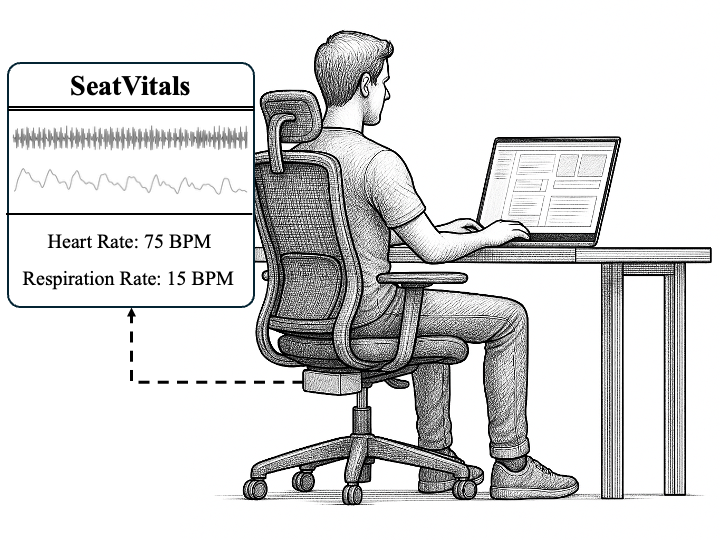
Real-time monitoring of vital signs in offices enables health promotion, stress management, and workplace optimization. This paper presents SeatVitals, a geophone-based system for unobtrusive and privacy-preserving monitoring of heartbeats and respiration, designed for seamless deployment under office chairs without user involvement. In workplace settings, however, the acquired signals are often heavily contaminated by diverse environmental noise, and labeling heartbeat time series remains inherently challenging. To address these issues, SeatVitals adopts a two-stage learning strategy. To overcome these challenges, SeatVitals first applies self-supervised contrastive learning on large-scale, high-quality sleep data with lower noise levels to learn stable feature representations. The model is then fine-tuned on limited, noisier seated data by aligning these representations with target labels. By leveraging abundant clean unlabeled data together with limited noisy labeled data, SeatVitals achieves both robust generalization and high accuracy in workplace vital sign estimation. Evaluation across 32 subjects yields a mean absolute error (MAE) of 2.44 bpm for heart rate (HR) and 2.20 bpm for respiration rate (RR). The system also achieves competitive performance with only 5% of labeled data for HR and 15% for RR, demonstrating strong label efficiency. These results highlight SeatVitals as a reliable and practical solution for healthcare and wellness monitoring in future smart offices.
@article{song2026seatvitals,
  title = {{SeatVitals}: Geophone-Based Contactless Vital Signs Estimation for Smart Office Health Sensing},
  author = {Song, Yingjian and Chen, Jiayu and Zhang, Yida and Zeng, Zixuan and Pitafi, Zaid Farooq and Phillips, Bradley G. and Zhang, Xiang and Lu, Qin and Song, Wenzhan},
  journal = {Computing in Cardiology (CinC)},
  year = {2026},
  url = {https://cinc.org/2026/Program/accepted/285.html},
}
2025
-
 Jiayu Chen, Yingjian Song, Yida Zhang, Zixuan Zeng, Xiang Zhang, Zaid Pitafi, Zaipeng Xie, Deepak Kumar Das, Nishan Dong, Junjie Lu, and othersProceedings of the ACM on Interactive, Mobile, Wearable and Ubiquitous Technologies, 2025
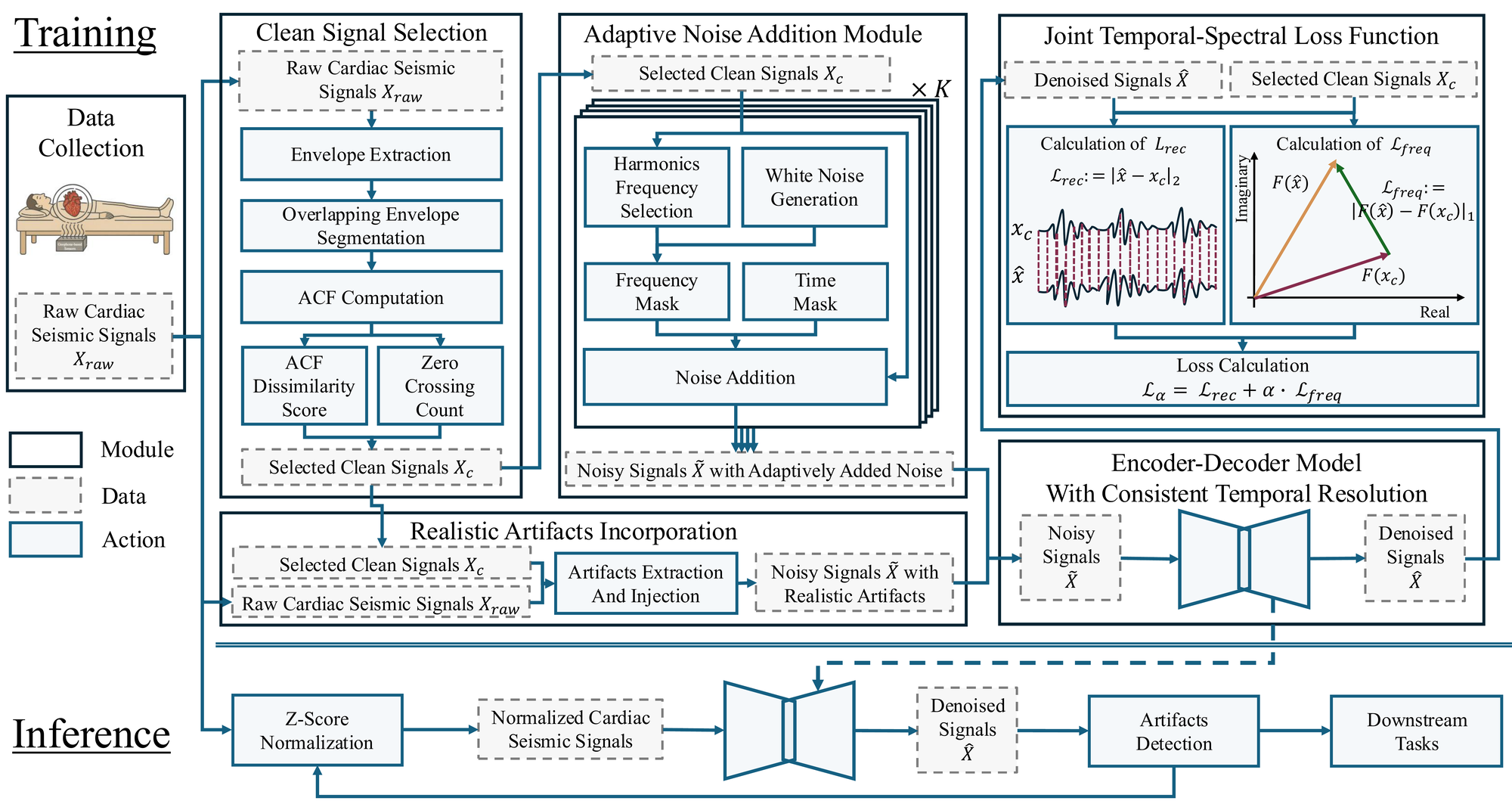
Cardiovascular diseases (CVDs) remain a major global health challenge, highlighting the urgent need for advanced cardiac monitoring solutions. Continuous, contactless cardiac monitoring using seismic sensors enables comfortable, privacy-preserving assessments by capturing subtle heart vibrations. However, these systems are highly susceptible to diverse noise sources. Existing denoising methods struggle to handle the complex noise in cardiac seismic signals and poorly leverage the abundant unlabeled data. To address these challenges, we propose SelfDenoiser, a self-supervised framework for denoising and reconstructing cardiac seismic signals using unlabeled data. During training, SelfDenoiser first selects clean segments from the unlabeled pool, then injects adaptive noise into each segment to simulate shared, hard-to-remove interference commonly observed in real-world noise distributions. In addition, realistic artifacts are extracted and integrated into clean signals to model high-intensity, abrupt noise events. An encoder-decoder network designed with fixed temporal resolution is subsequently trained to recover the clean signals, guided by a loss function that captures both temporal and spectral characteristics. We evaluated SelfDenoiser on 11,392 hours of data collected in an Intensive Care Unit (ICU) using seismic sensor-based systems. The model was trained on 610 hours of clean signals selected from a 5176-hour unlabeled pool and tested on a 6216-hour labeled dataset. Results showed substantial improvements in two downstream tasks: heart rate (HR) and inter-beat interval (IBI) estimation, with notably increased data utilization and better accuracy compared to conventional denoising methods. This highlights SelfDenoiser’s capability to transform low-quality, noisy signals into high-fidelity, reliable cardiac data.
@article{chen2025selfdenoiser, title = {SelfDenoiser: Self-supervised Seismic Signal Denoiser for Continuous and Contactless Cardiac Monitoring}, author = {Chen, Jiayu and Song, Yingjian and Zhang, Yida and Zeng, Zixuan and Zhang, Xiang and Pitafi, Zaid and Xie, Zaipeng and Das, Deepak Kumar and Dong, Nishan and Lu, Junjie and others}, journal = {Proceedings of the ACM on Interactive, Mobile, Wearable and Ubiquitous Technologies}, volume = {9}, number = {4}, pages = {1--31}, year = {2025}, publisher = {ACM New York, NY, USA}, doi = {10.1145/3770701}, url = {https://dl.acm.org/doi/abs/10.1145/3770701}, } -
 Yingjian Song, Haotian Xiang, Zixuan Zeng, Jiayu Chen, Yida Zhang, Zaid Farooq Pitafi, He Yang, Qin Lu, Xiang Zhang, Bradley G Phillips, and othersProceedings of the ACM on Interactive, Mobile, Wearable and Ubiquitous Technologies, 2025
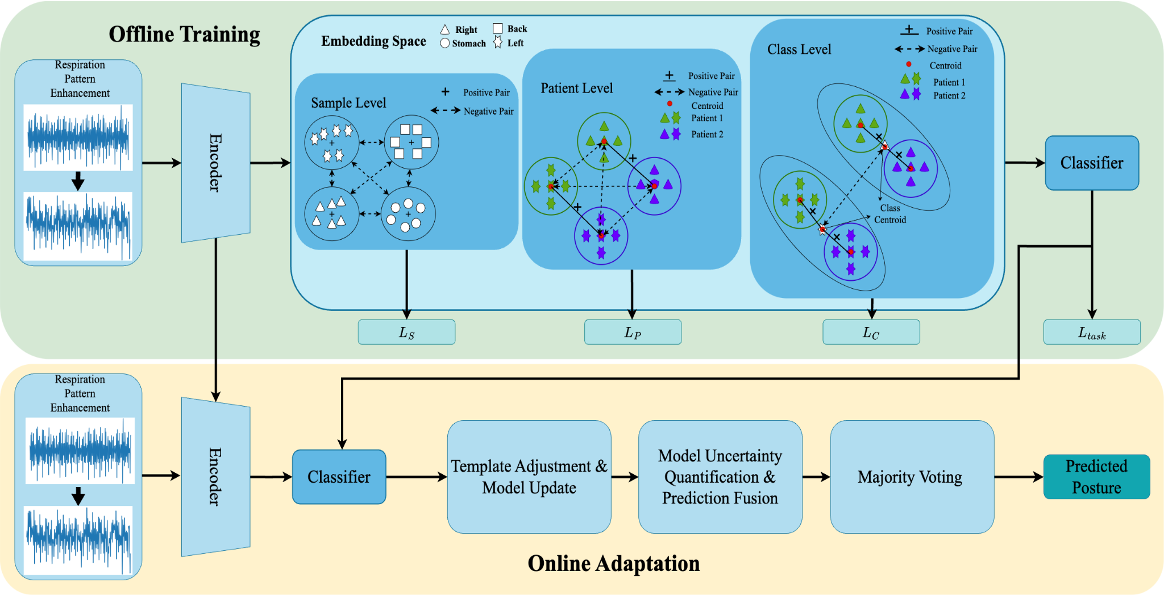
In-bed postures offer valuable information about an individual’s sleep quality and overall health conditions, particularly for patients with sleep apnea. However, current in-bed posture classification systems lack privacy-friendly and easy-to-install options. Furthermore, existing solutions do not consider variations between patients and are typically trained only once, neglecting the utilization of time consistency and unlabeled data from new patients. To address these limitations, this paper builds on a seismic sensor to introduce a novel sleep posture framework, which comprises two main components, namely, the Multi-Granularity Supervised Contrastive Learning (MGSCL) module and the ensemble Online Adaptation (oa) module. Unlike most existing contrastive learning frameworks that operate at the sample level, MGSCL leverages multi-granular information, operating not only at the sample level but also at the group level. The oa module enables the model to adapt to new patient data while ensuring time consistency in sleep posture predictions. Additionally, it quantifies model uncertainty to generate weighted predictions, further enhancing performance. Evaluated on a dataset of 100 patients collected at a clinical research center, MGSCLoa achieved an average accuracy of 91.67% and an average F1 score of 91.53% with only 40 seconds of labeled data per posture. In a Phase 2 evaluation with 11 participants over 13 nights in home settings, the framework reached an average accuracy of 85.37% and a weighted F1 score of 83.59% using just 3 minutes of labeled data per common posture for each participant. These results underscore the potential of seismic sensor-based in-bed posture classification for assessing sleep quality and related health conditions.
@article{song2025multi, title = {Multi-granularity Supervised Contrastive Learning with Online Adaptation for Contactless In-bed Posture Classification}, author = {Song, Yingjian and Xiang, Haotian and Zeng, Zixuan and Chen, Jiayu and Zhang, Yida and Pitafi, Zaid Farooq and Yang, He and Lu, Qin and Zhang, Xiang and Phillips, Bradley G and others}, journal = {Proceedings of the ACM on Interactive, Mobile, Wearable and Ubiquitous Technologies}, volume = {9}, number = {2}, pages = {1--32}, year = {2025}, publisher = {ACM New York, NY, USA}, url = {https://dl.acm.org/doi/abs/10.1145/3729464}, doi = {10.1145/3729464} } -
 Yida Zhang, Jiayu Chen, Yingjian Song, Zixuan Zeng, Xiang Zhang, Qin Lu, Bradley G Phillips, Zaipeng Xie, and Wenzhan SongIn Proceedings of the ACM/IEEE International Conference on Connected Health: Applications, Systems and Engineering Technologies, 2025
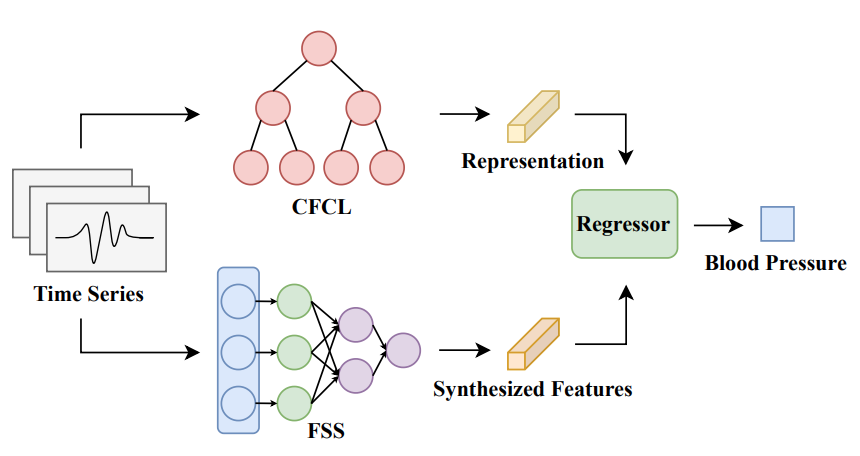
Effective blood pressure estimation during sleeping is crucial for the monitoring of a wide range of diseases. In recent years, different types of vibration signals induced by cardiac activities have been widely studied for blood pressure estimation. However, most existing methods either rely on manual feature identification, requiring extensive physiological expertise and extensive experiments, or employ deep learning (DL) models, which struggle with domain shifts in temporal signals. In this paper, we propose an innovative blood pressure estimation framework called CLFSS, using coarse-to-fine Contrastive Learning, Feature Selection and Synthesis. Within CLFSS, BedDot, a custom-designed vibration detector based on seismometer, is first used to capture subtle vibration signals generated by cardiac activities. Then an innovative Coarse-to-Fine Contrastive Learning (CFCL) module is designed to generate generalizable representations across different granularities, leveraging the principles of contrastive learning with a divide-and-conquer strategy. Meanwhile, to utilize the potentially relevant physiological features from a large feature set, a one-to-one connected layer with Lasso regularization is created to reveal related features, which are then synthesized to form features with high-level semantic information. Finally, the proposed CLFSS effectively aggregates the representations and synthesized features, achieving accurate blood pressure estimation. Experiments are conducted on public and private datasets, clearly demonstrating that CLFSS can accurately select the related features and achieve low Mean Absolute Error (MAE) on blood pressure estimation. In addition, the experimental results are in compliance with the standards established by the Food and Drug Administration (FDA), demonstrating significant real-world potential.
@inproceedings{zhang2025blood,
  title = {Blood Pressure Estimation from Vibration Signals via Coarse-to-Fine Contrastive Learning, Feature Selection and Synthesis},
  author = {Zhang, Yida and Chen, Jiayu and Song, Yingjian and Zeng, Zixuan and Zhang, Xiang and Lu, Qin and Phillips, Bradley G and Xie, Zaipeng and Song, Wenzhan},
  booktitle = {Proceedings of the ACM/IEEE International Conference on Connected Health: Applications, Systems and Engineering Technologies},
  pages = {134--138},
  year = {2025},
  url = {https://dl.acm.org/doi/abs/10.1145/3721201.3721395},
  doi = {10.1145/3721201.3721395}
}